
The Stone of Sky and History: A Deep Dive into December’s Turquoise
December is a month of paradoxes. It brings the longest nights of the year, yet it is celebrated with the brightest lights. It is a time of cold earth and dormant nature, yet its birthstone—Turquoise—is the very embodiment of life, water, and the summer sky.
For many, Turquoise is misunderstood. Often relegated to casual summer jewelry or bohemian trends, this gemstone carries a weight of history and nobility that rivals the diamond. It is one of the oldest talismans known to humanity, a stone that has protected kings, adorned temples, and served as a bridge between the mortal world and the divine.
As we celebrate the December birthdays, we invite you to look beyond the surface. This is not just a blue stone; it is a geological miracle and a cultural icon. Let’s explore the profound journey of the “Sky Stone.”

An Odyssey Across Civilizations
Long before it was a fashion statement, Turquoise was a currency of power. Its usage spans over 6,000 years, making it arguably the first gemstone ever mined and utilized by civilization.
The Pharaoh’s Protector In Ancient Egypt, Turquoise was mined in the blistering heat of the Sinai Peninsula. It was so revered that the Egyptians called it mefkat, meaning “joy” and “delight.” The iconic burial mask of King Tutankhamun is inlaid with turquoise, symbolizing rebirth. The Egyptians believed the stone had the power to protect the soul in its journey through the afterlife, its color representing the rising sun at dawn.
The Persian Ideal Traveling east to ancient Persia (modern-day Iran), the stone was known as pērōzah, meaning “victory.” Here, the aesthetic ideal was different. While other cultures appreciated the patterns in the stone, the Persians sought the purest, most uniform “robin’s egg blue.” This specific shade was so spiritually significant that it was used to cover the domes of great mosques and palaces, symbolizing the heavens brought down to earth. This is where we get the term “Persian Blue,” a standard still used to judge turquoise quality today.
The Heart of the Southwest Across the ocean, to the Native American tribes of the American Southwest (Navajo, Zuni, Hopi), Turquoise was—and remains—sacred. It is the “Skystone,” believed to be pieces of the sky that fell to earth. It is intrinsically linked to water and rain, a precious commodity in the desert. For these cultures, wearing turquoise is a prayer for health, rain, and protection.

The Geology of Thirst: How It Forms
Why is Turquoise found in such specific, arid locations like Arizona, Iran, and Egypt? Because Turquoise is, quite literally, a child of thirst.
Biologically and chemically, it is a hydrous phosphate of copper and aluminum. It forms only in dry, barren regions where water is scarce but mineral-rich.
The process begins when acidic, copper-rich groundwater trickles down through rocks. As it moves, it reacts with minerals containing aluminum and phosphorus. Over millions of years, this mineral-rich soup deposits into cracks, voids, and crevices in the host rock, solidifying into the nodules we find today.
The Blue: Comes from Copper. The more copper present, the bluer the stone.
The Green: Comes from Iron. If iron replaces some of the aluminum, the stone shifts towards greener, teal hues.
It is poetic to think that this vibrant, water-colored gem can only be born in the driest deserts on Earth. It is nature’s way of preserving the memory of water in stone.
The “Matrix”: Understanding Imperfection
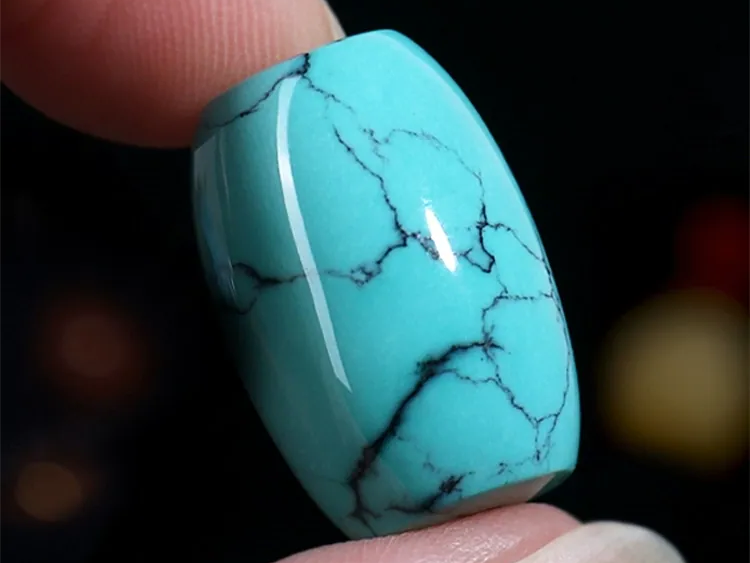
One of the most debated topics in the world of gemstones is the Matrix—the web-like veins that run through many Turquoise stones.
In the high-jewelry markets of the Victorian era and mid-century Europe, the matrix was often considered a flaw. They wanted the flawless “Sleeping Beauty” blue (named after the famous mine in Arizona that produced distinctively clear stones).
However, modern collectors have developed a deep appreciation for the matrix. These lines are remnants of the “host rock” (often limonite or sandstone) where the turquoise formed. Like a fingerprint, no two matrix patterns are alike.
Boulder Turquoise: A style where the turquoise is cut with the host rock, creating a rustic, earthy contrast between the brown rock and the vibrant blue vein.
Spiderweb Matrix: A rare and highly valued pattern where the lines form a tight, intricate net.
Whether you prefer the pristine blue of the Persian style or the rugged storytelling of a heavy matrix, both are geologically correct and aesthetically valid.

The “Matrix”: Understanding Imperfection
One of the most debated topics in the world of gemstones is the Matrix—the web-like veins that run through many Turquoise stones.
In the high-jewelry markets of the Victorian era and mid-century Europe, the matrix was often considered a flaw. They wanted the flawless “Sleeping Beauty” blue (named after the famous mine in Arizona that produced distinctively clear stones).
However, modern collectors have developed a deep appreciation for the matrix. These lines are remnants of the “host rock” (often limonite or sandstone) where the turquoise formed. Like a fingerprint, no two matrix patterns are alike.
- Spiderweb Matrix: A rare and highly valued pattern where the lines form a tight, intricate net.
- Boulder Turquoise: A style where the turquoise is cut with the host rock, creating a rustic, earthy contrast between the brown rock and the vibrant blue vein.
Whether you prefer the pristine blue of the Persian style or the rugged storytelling of a heavy matrix, both are geologically correct and aesthetically valid.
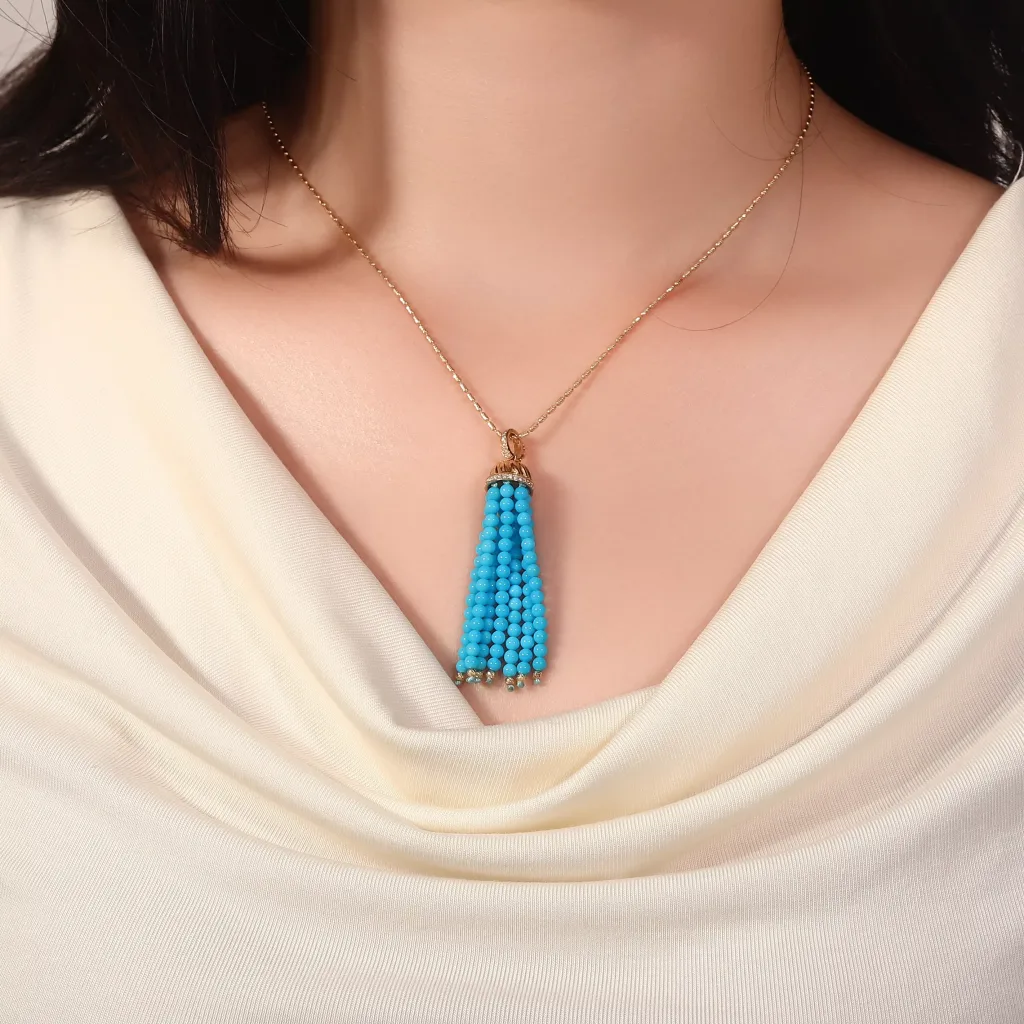
If you own a piece of Turquoise, you are the custodian of a “living” gem. Unlike diamonds or sapphires, which are inert and non-porous, Turquoise is porous. It breathes.
This porosity means that Turquoise can absorb liquids, oils, and chemicals. Over decades, a natural turquoise stone might slowly change color, often turning greener as it interacts with the natural oils of the wearer’s skin. In ancient times, this color change was thought to warn the wearer of impending illness or danger. In reality, it was simply chemistry.


